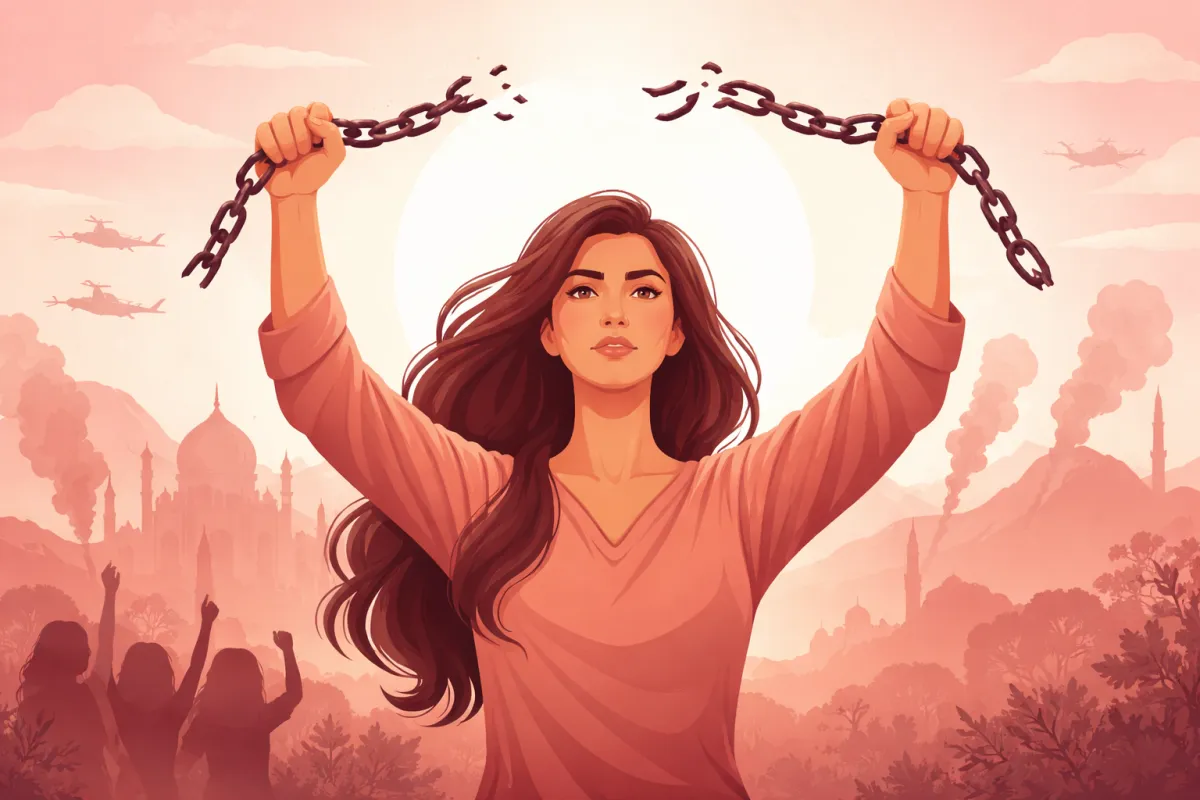
War, Freedom, and a Question About Power
War, Freedom, and a Question About Power
If you look across the long arc of history, one pattern becomes hard to ignore.
Organised warfare has overwhelmingly been directed by men.
Kings and emperors commanded armies.
Generals planned campaigns.
Modern wars have been declared and fought largely under male political leadership.
That pattern is not surprising when you remember that political and military power historically belonged almost entirely to men, and still does.
Women rarely held or hold those positions.
So the history of war reflects the history of power.
But while armies were being raised and borders fought over, women in many parts of the world were engaged in a different struggle.
The struggle for rights.
The Long Movement for Women’s Rights
For centuries women lacked legal freedoms that men possessed as a matter of course.
In many societies women could not vote.
They could not own property independently.
They could not study in universities.
They could not enter most professions.
These restrictions changed slowly over time.
Women organised campaigns.
They wrote, protested, and challenged laws that excluded them.
By the twentieth century, many countries had begun to dismantle those barriers.
Women entered universities, professions, and political life in increasing numbers.
In large parts of the world, the transformation was dramatic.
But history rarely moves evenly.
Even today the rights of women and girls differ widely depending on where they are born.
The Case of Iran
Iran is a complex country with a long history and a diverse society.
Since the Iranian Revolution, the country has operated under a system of religious governance that includes laws regulating aspects of public life, including dress codes for women.
In 2022 the death of Mahsa Amini while in police custody sparked protests across the country.
Many women publicly removed their headscarves.
Demonstrations spread through cities and universities.
The slogan associated with the protests was 'Woman, Life, Freedom'.
The events drew international attention and prompted widespread discussion about women’s rights in Iran.
The Iranian government has maintained that its laws reflect the country’s legal and cultural framework.
Critics argue that those laws restrict women’s freedoms.
The issue remains a subject of intense debate both within Iran and internationally.
A Reminder from Britain’s Own History
It is easy to look at restrictions on women in other countries and imagine that such things belong to a different world.
But Britain’s own history shows a more complicated story.
Not so long ago, women here lived under strict social and legal limitations.
Girls’ education was often designed not to develop intellectual independence, but to prepare them to become suitable wives.
Married women could not fully control their own property until the late nineteenth century, when reforms such as the Married Women's Property Act 1882 began to change the law.
Women could not vote in national elections until the early twentieth century, and even then the right was granted gradually. In 1918 only some women were included (over 30, own their own property), and full voting equality with men did not arrive until 1928.
Social expectations were also strict.
Victorian standards of modesty regulated how women dressed, behaved, and participated in public life.
These rules were not identical to modern restrictions in other countries, but they remind us of something important.
The freedoms many people take for granted today were won slowly, often through decades of effort.
A Moment of International Strain
These questions about freedom are also unfolding during a period of international tension.
Iran has long had difficult relations with several Western countries, and the region has seen recurring cycles of conflict and confrontation.
Periods like this tend to change the atmosphere inside countries.
When governments feel under pressure from outside forces, political authority often tightens. Public debate can become more cautious, and reform movements sometimes find less space to operate.
History shows that struggles for rights rarely develop in calm conditions.
They often emerge while societies are navigating much larger questions about power, security, and national identity.
A Reflection
Looking across these histories invites a wider thought about independence.
Over the past century, women in many countries have gained access to education, professions, and public life in ways that earlier generations could not have imagined.
Legal equality has expanded.
Opportunities have widened.
Yet another question sometimes emerges later in life.
Economic independence.
Participation in the workforce does not always translate into long-term financial security or control over income.
Many people, women and men alike, spend decades working within institutions they do not own.
Employers.
Professions.
Systems that can change unexpectedly.
For some, this leads to a further question about independence.
Not only political freedom, but economic autonomy.
The ability to shape one’s own future rather than relying entirely on structures created by others.
That question appears in different forms across the world, and across different stages of life.
A Continuing Conversation
None of these questions have simple answers.
The history of war, politics, and women’s rights is complex and often shaped by circumstances far beyond any individual.
But one observation seems clear.
Across the world today, women are still asking questions about freedom, opportunity, and independence.
Sometimes those questions appear in public protests.
Sometimes they appear quietly in conversations about work, autonomy, and the future.
History suggests that when those questions are asked persistently enough, change often follows.
Deb Gourley
Freedom Builder Against Ordinary


